
Category: Deep Learning
-
Optimization diaries: S/P ping-pong for FlashAttention-4 decode

LLM Inference is divided into a prefill phase and a decode phase. During prefill, the model processes a large number of input tokens and populates a key-value (KV) cache. During decode, it autoregressively generates one or a few new tokens at a time using the cached keys and values. In this blog post, we discuss… Go to article…
-
Optimization diaries: Improving FlashAttention-4 backward pass kernel design for head dimension 64
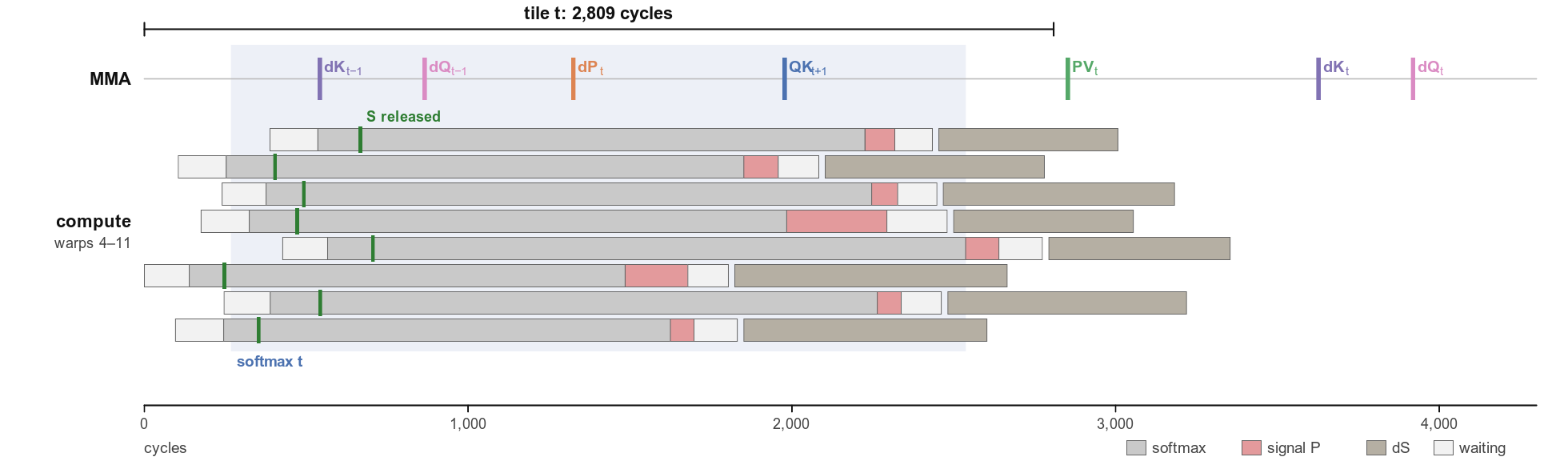
In this blog post we discuss the backward pass of FlashAttention-4 (FA4) on NVIDIA Blackwell GPUs. For head dimension 128, FA4 backward is highly performant, achieving 1237 TFLOP/s, or about 55% of peak compute throughput on a B200 GPU. However, at head dimension 64, the same kernel achieves only 30–37% of peak compute throughput for… Go to article…
-
GPU Mode: Fundamentals of CuTe Layout Algebra and Category-Theoretic Interpretation
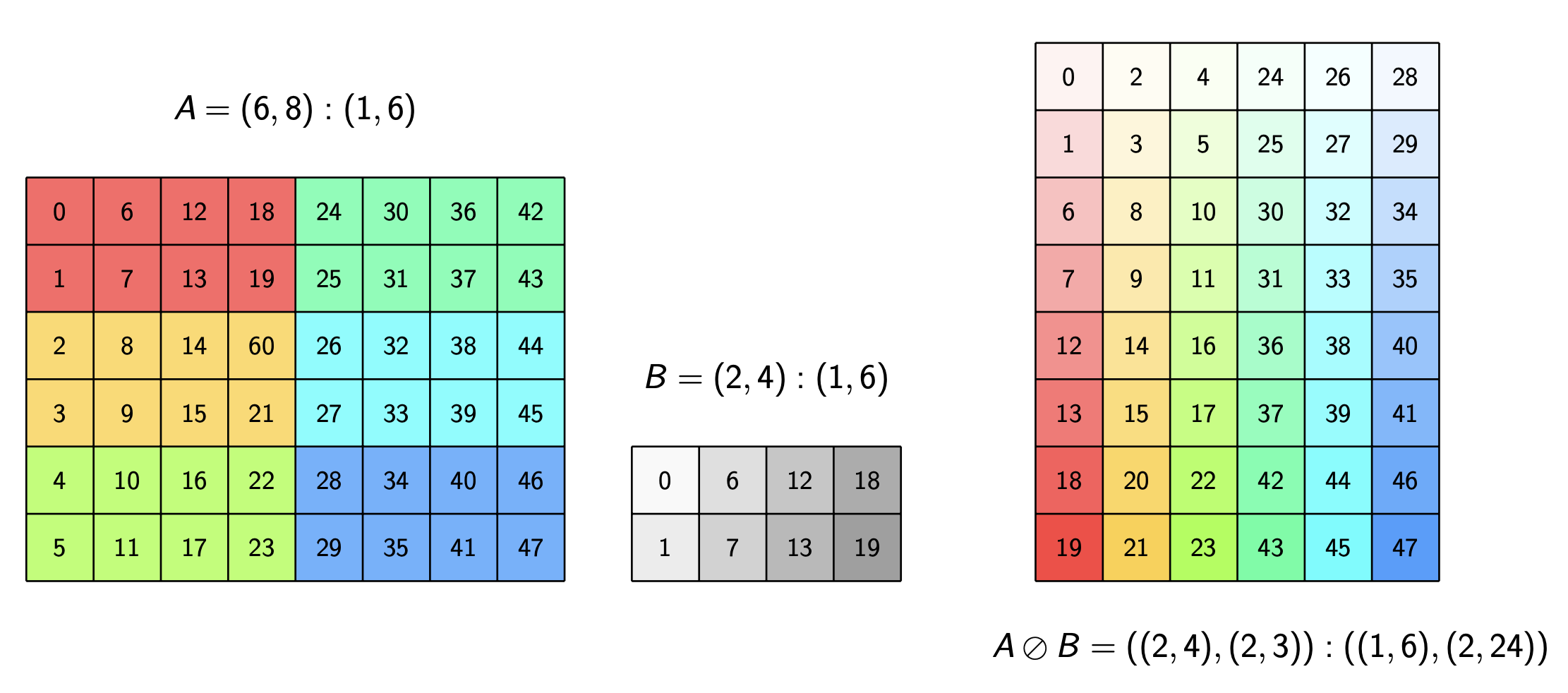
In this GPU Mode lecture, Jack Carlisle reviews the fundamental concepts of CuTe layout algebra and then presents our category-theoretic mathematical framework for understanding layouts and their algebraic structure. Go to article…
-
FlexAttention + FlashAttention-4: Fast and Flexible (External)

In this PyTorch blog on which we collaborated, we explain the FlexAttention extension to FlashAttention-4 (or from another point of view, the incorporation of FA-4 as an attention backend for the PyTorch FlexAttention API). Go to article…
-
FlashAttention-4: Algorithm and Kernel Pipelining Co-Design for Asymmetric Hardware Scaling
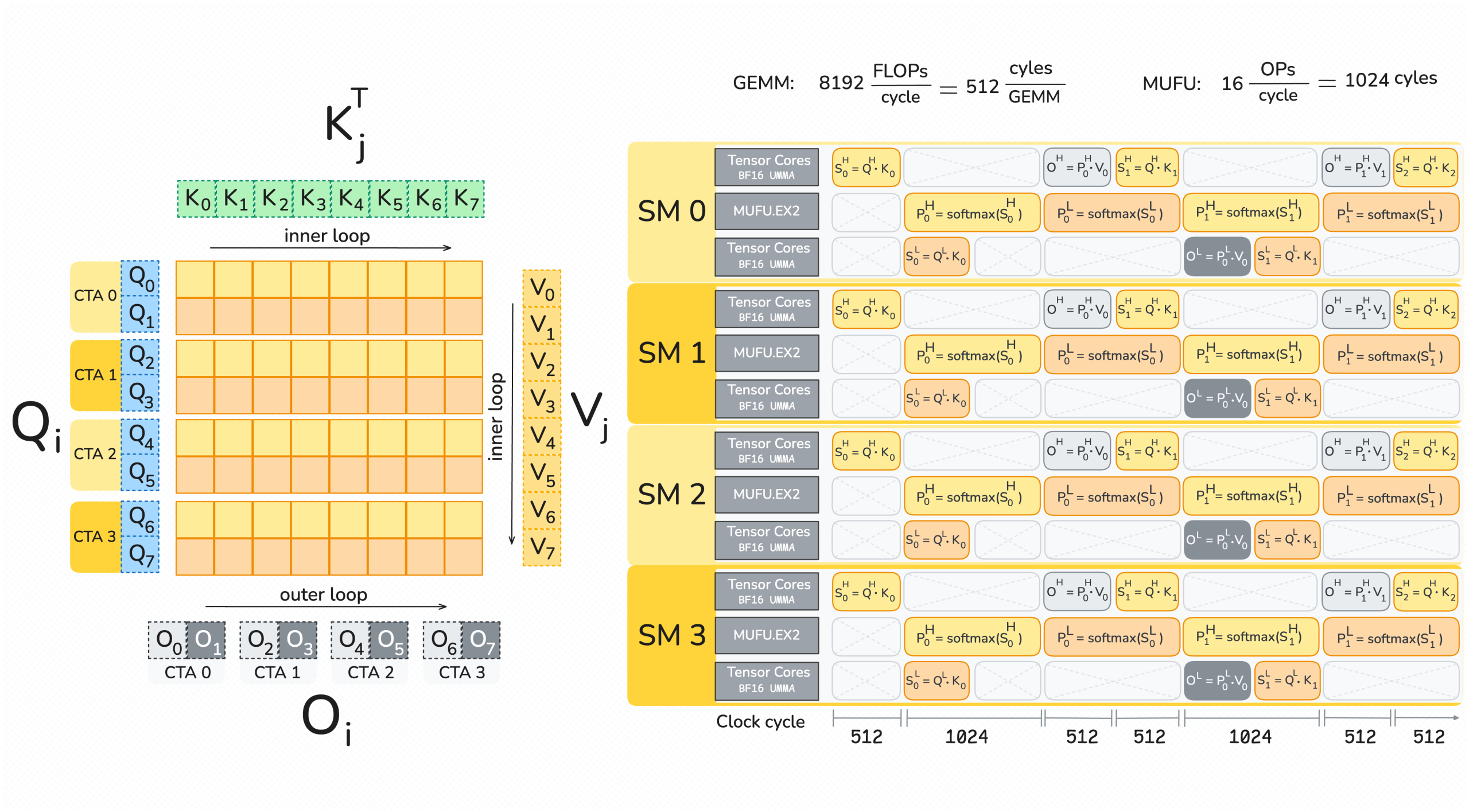
Modern accelerators like Blackwell GPUs continue the trend of asymmetric hardware scaling, where tensor core throughput grows far faster than other resources such as shared memory bandwidth, special function units (SFUs) for transcendental operations like exponential, and general-purpose integer and floating-point ALUs. From the Hopper H100 to the Blackwell B200, for instance, BF16 tensor core… Go to article…
-
FlashAttention-3 for Inference: INT8 Quantization and Query Head Packing for MQA/GQA (External)
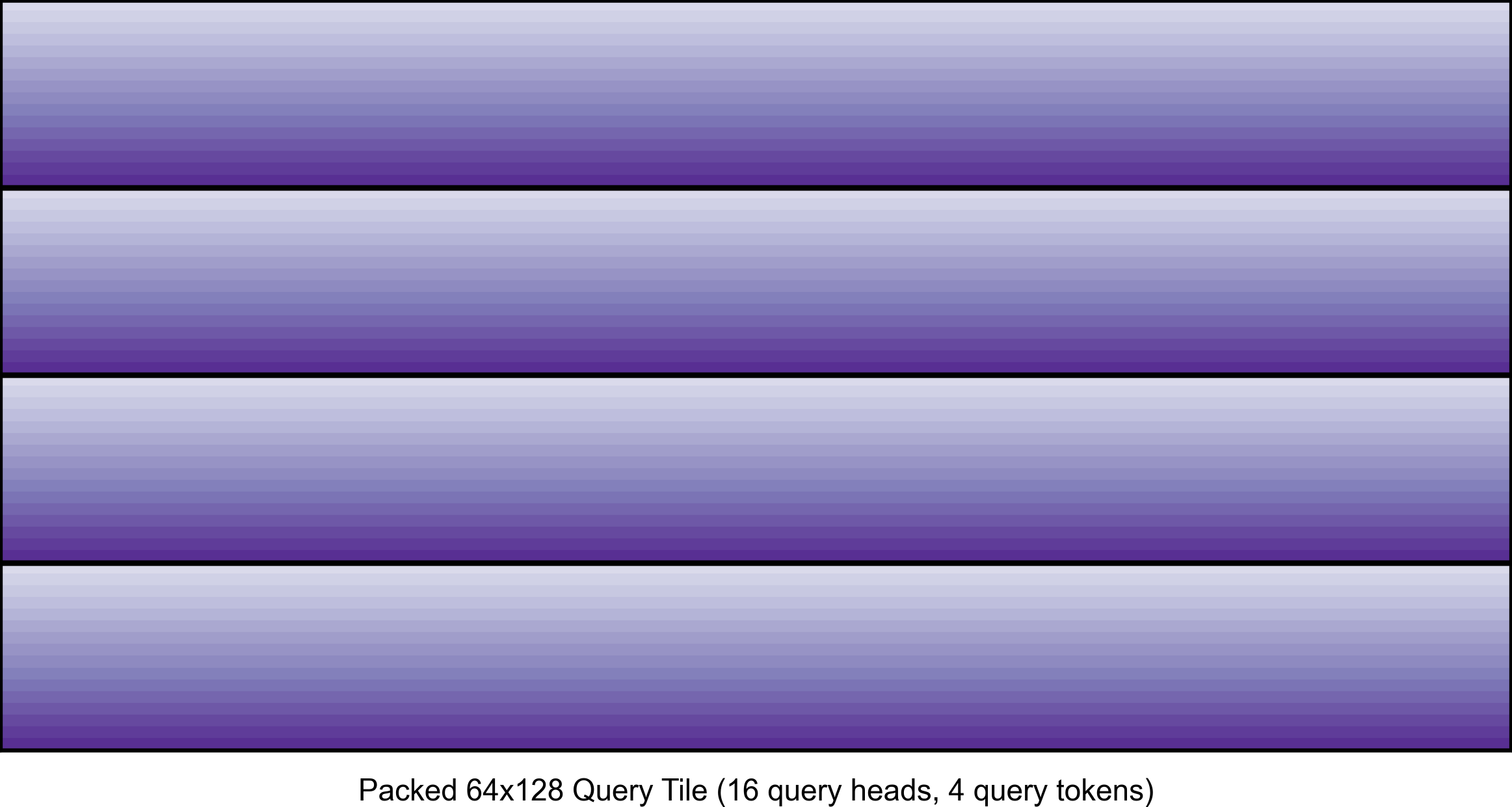
In this blog post presented on the Character.AI research blog, we explain two techniques that are important for using FlashAttention-3 for inference: in-kernel pre-processing of tensors via warp specialization and query head packing for MQA/GQA. Go to article…
-
GPU Mode: CUTLASS and FlashAttention-3
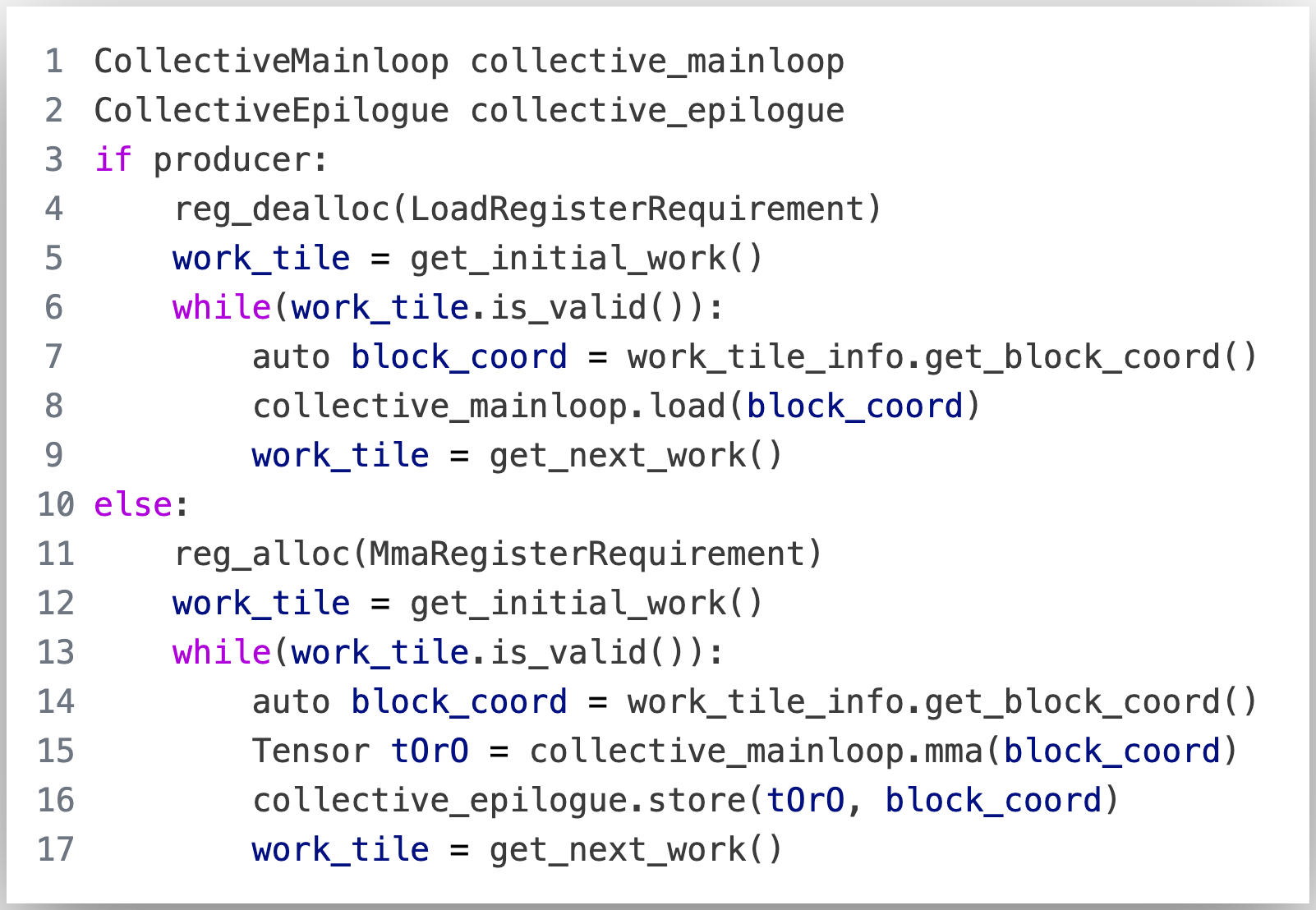
In this GPU Mode lecture, Jay Shah presents his joint work on FlashAttention-3 and how to implement the main compute loop in the algorithm using CUTLASS. The code discussed in this lecture can be found at this commit in the FlashAttention-3 codebase. Note: Slides adapted from a talk given by Tri Dao. Go to article…
-
Epilogue Fusion in CUTLASS with Epilogue Visitor Trees
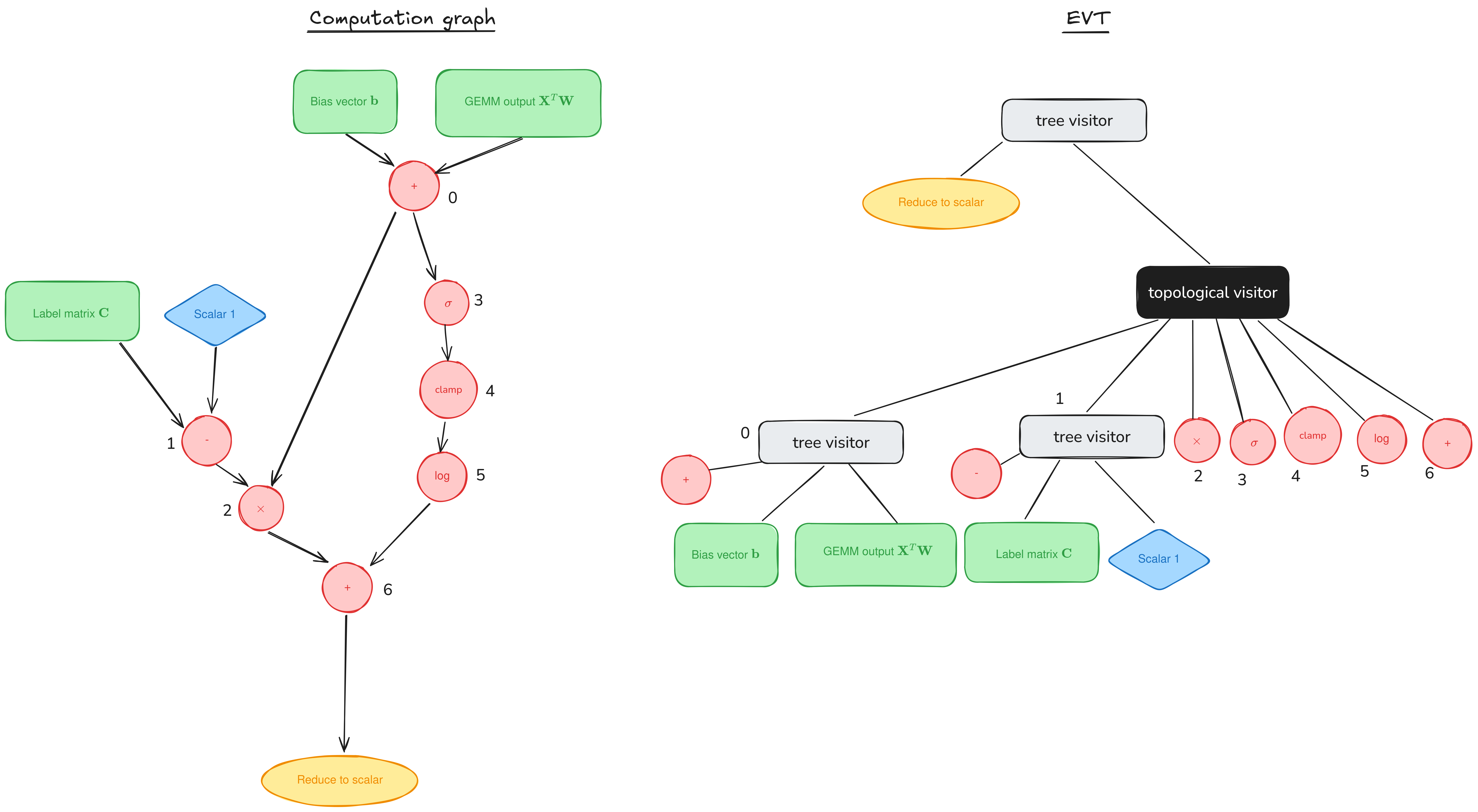
Welcome to a supplemental article for our tutorial series on GEMM (GEneral Matrix Multiplication). Posts in the main series (1, 2) have discussed performant implementations of GEMM on NVIDIA GPUs by looking at the mainloop, the part responsible for the actual GEMM computation. But the mainloop is only a part of the CUTLASS workload. In… Go to article…
-
FlashAttention-3: Fast and Accurate Attention with Asynchrony and Low-precision
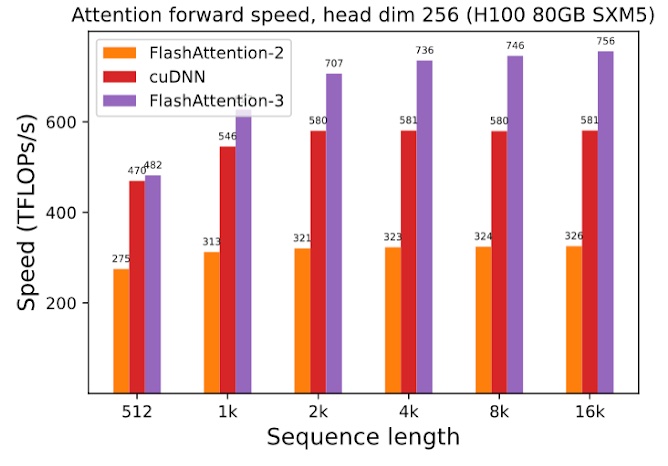
In this blogpost, we describe three main techniques that we use to speed up attention on Hopper GPUs in FlashAttention-3: exploiting asynchrony of the Tensor Cores and TMA to (1) overlap overall computation and data movement via warp-specialization and (2) interleave block-wise matmul and softmax operations, and (3) incoherent processing that leverages hardware support for… Go to article…
-
Delivering 1 PFLOP/s of Performance with FP8 FlashAttention-2
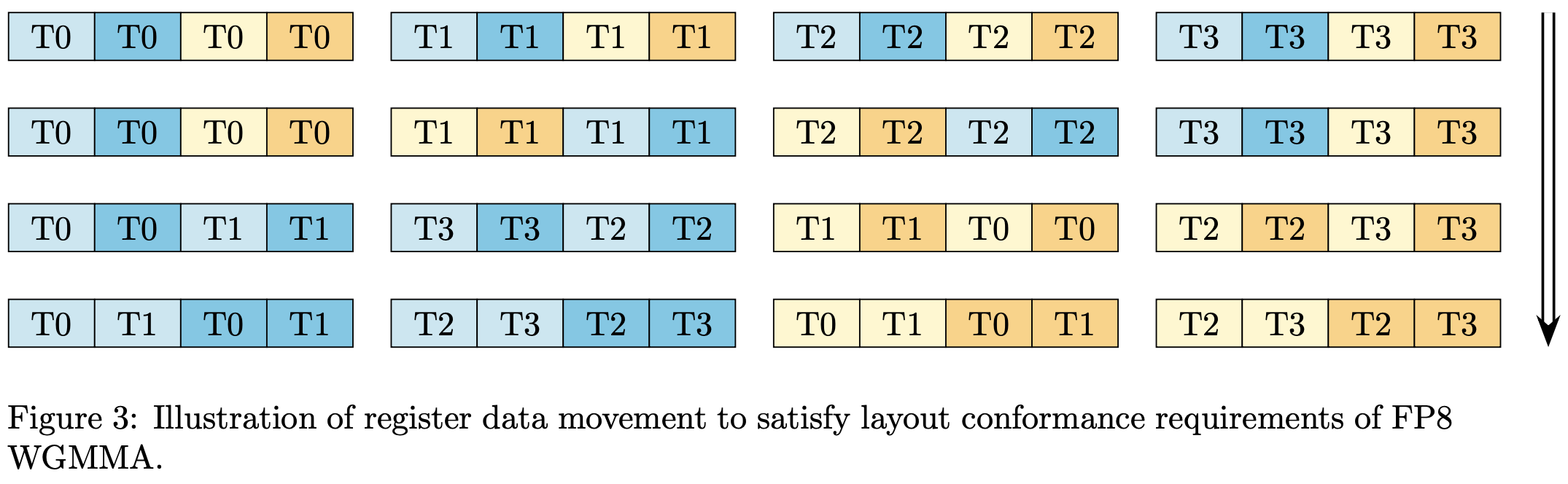
We recently released an update to our FlashAttention-2 forward pass implementation on NVIDIA Hopper™ architecture that incorporates a number of new optimizations and improvements, including a software pipelining scheme and FP8 support. In this article, we will explain a challenge with achieving layout conformance of register fragments for WGMMA instructions that we encountered in the… Go to article…